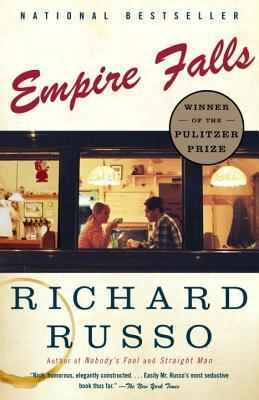
by Karen Yvonne Hamilton, 2026 (originally written in 2001)
GOODREADS SYNOPSIS
Welcome to Empire Falls, a blue-collar town full of abandoned mills whose citizens surround themselves with the comforts and feuds provided by lifelong friends and neighbors and who find humor and hope in the most unlikely places, in this Pulitzer Prize-winning novel by Richard Russo.
Miles Roby has been slinging burgers at the Empire Grill for 20 years, a job that cost him his college education and much of his self-respect. What keeps him there? It could be his bright, sensitive daughter Tick, who needs all his help surviving the local high school. Or maybe it’s Janine, Miles’ soon-to-be ex-wife, who’s taken up with a noxiously vain health-club proprietor. Or perhaps it’s the imperious Francine Whiting, who owns everything in town–and seems to believe that “everything” includes Miles himself. In Empire Falls Richard Russo delves deep into the blue-collar heart of America in a work that overflows with hilarity, heartache, and grace.
MY REVIEW
Charlie Mayne tells Miles that
“There are things that grown-ups intend and want to do, but somehow just can’t.”
In all of Empire Falls, this theme is echoed. There are dreams denied or put on hold. There are characters desperately trying to do what they think is right but failing miserably. The entire town is moving in slow motion toward their own individual explosions.
The novel itself meanders along, like the Knox River. Russo says in the Preface,
“What water wanted to do…was flow downhill by the straightest possible route. Meandering was what happened when a river’s best intentions were somehow thwarted.”
This is what the population of Empire Fall’s has been doing for twenty years – meandering. To emphasize this theme, Russo himself meanders, oftentimes leaving the reader wondering when something dramatic would happen.
In life, this is what so many people do also. People are always waiting for something to happen, always hoping that their waiting is the right thing to do and everything will come out right in the end. But all this attitude does is cause a build up that explodes in the end, as can be seen in the events that unfold in the last chapters of the novel.
Russo won the Pulitzer Prize for this novel. The paragraph above emphasizes the main reason that I find for the novel being such a success. The manner in which Russo is able to actually weave this concept of ‘waiting’ into his story by creating a feeling of time moving slowly, of anticipation.
By the middle of the novel, I was ready to explode with frustration – I, like the residents of Empire Falls, was desperately waiting for something big to happen. Towards the end of the novel, Tick is thinking to herself and she says,
“Just because things happen slow doesn’t mean you’ll be ready for them. If they happened fast, you’d be alert for all kinds of suddenness…”
and
“Slow works on an altogether different principle, on the deceptive impression that there’s plenty of time to prepare…”
Certainly, in this novel the reader could never be ready for the climax at the end. You are lulled into a sense of complacency that sets the tone for the suddenness of the end of the story. There is never ‘plenty of time to prepare’ in this life because there is no way of ever knowing what twist life is going to throw next.
 Other Rivers
Leave a comment